



Enterprise SEO needs more than a position checker. When you manage thousands of keywords across regions, brands, and devices, the real challenge is producing numbers your analysts can investigate and your leadership can act on. The right rank tracking software needs scale, meaningful segmentation, dependable history, and a reporting workflow that supports decisions.
This 2027 buyer’s guide compares ten established options for different enterprise jobs: deep SERP analysis, large-scale tracking, cross-team governance, agency reporting, and competitive intelligence. It also explains how to evaluate AI search visibility without confusing a brand mention in ChatGPT with a traditional Google ranking.
Planning note: This is a 2027 planning guide based on product information publicly available in October 2026. Features and prices can change; request current quotes and confirm plan limits before purchasing.
Enterprise rank tracking software at a glance
| Platform | Best suited to | Key buying question |
|---|---|---|
| Rankability Tracker | Blended search and AI visibility | Can stakeholders see what contributes to the score? |
| Nozzle | Granular SERP diagnostics | What is the cost per SERP and market? |
| STAT Search Analytics | High-volume keyword and market tracking | How many tracked keywords and locations? |
| Semrush | Rank tracking plus competitive research | Are project and reporting allowances enough? |
| Ahrefs | Rank, links and content investigations | How often are local ranks refreshed? |
| seoClarity | Enterprise workflow and governance | Which workflows and integrations are included? |
| BrightEdge | Executive reporting and standardized programs | How much onboarding is required? |
| Conductor | Cross-team SEO coordination | Can teams turn insights into tasks? |
| SEOmonitor | Forecasting and agency ROI reporting | Which forecast assumptions are adjustable? |
| Similarweb | Market and competitor context | Do we need market intelligence or raw ranks? |
How to choose an enterprise rank tracker in 2027
Start with the decisions the dashboard must support. A retailer tracking visibility in 300 cities has different requirements from a global SaaS brand measuring five languages or an SEO agency delivering reports to fifty clients. Buying the most feature-rich platform without defining your reporting model often creates unnecessary expense.
- Collection scale: Calculate the true keyword × location × device × frequency combinations, not simply the number of keywords.
- Search-result detail: Determine whether you need traditional ranks only or also local packs, featured snippets, shopping modules, and AI surfaces.
- Governance: Confirm permissions, single sign-on, brand isolation, history retention, and auditability where required.
- Data movement: Ask about APIs, scheduled exports, Looker Studio, warehouse pipelines, and any limits on exporting historical data.
- Reporting usefulness: Define how you will segment brand/non-brand, topics, product lines, and business-value keywords.
- Business interpretation: Connect ranking movement to Search Console, organic landing-page performance, qualified leads, and conversions.
The 10 best enterprise rank tracking tools for 2027
1. Rankability Tracker — Best for unified google and ai search reporting
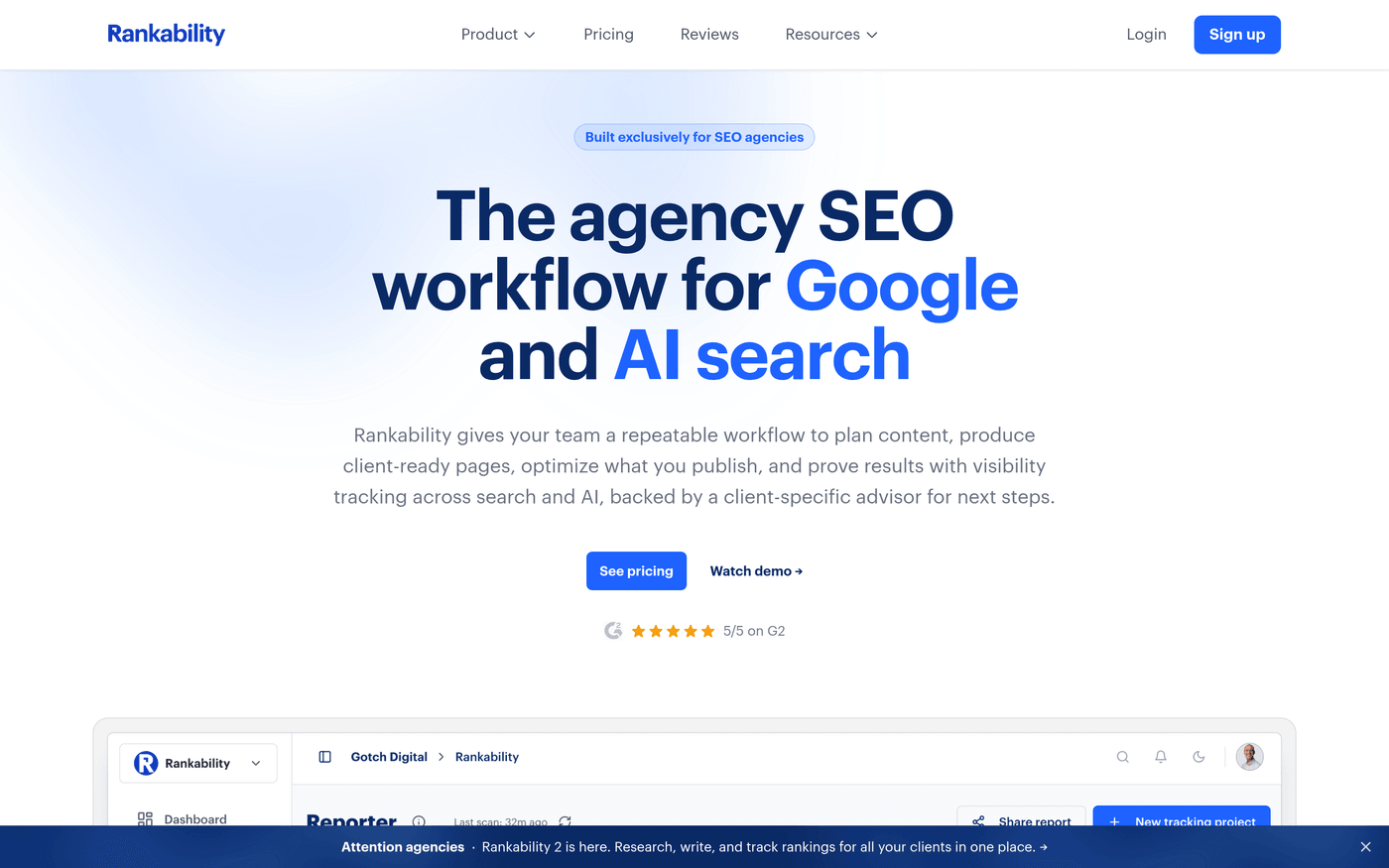
Best for: Agencies that need a client-friendly visibility narrative alongside a repeatable content and reporting workflow.
Rankability is aimed at teams that want their search reporting to move beyond a spreadsheet of blue-link positions. A composite visibility view can help stakeholders discuss traditional results, local exposure, and emerging AI discovery within the same reporting conversation. The benefit is particularly clear when an agency presents results to clients who do not want to reconcile several disconnected dashboards.
The important buying question is how the combined score is calculated. A single number is convenient for an executive presentation, but it should never hide the underlying keyword set, geographic settings, crawl frequency, or movements by search surface. Ask for a dashboard demonstration using actual brand and non-brand keyword groups.
What to look for
- Practical strength: Unified Google and AI search reporting.
- Before purchasing: A composite score is only useful if every component remains auditable. Before committing, verify keyword and AI-query allowances, historical retention, permissions, and the export options included with your plan.
Velautec perspective: Ask for a pilot across two markets and a defined group of commercially important keywords.
2. Nozzle — Best for detailed serp intelligence and custom segmentation
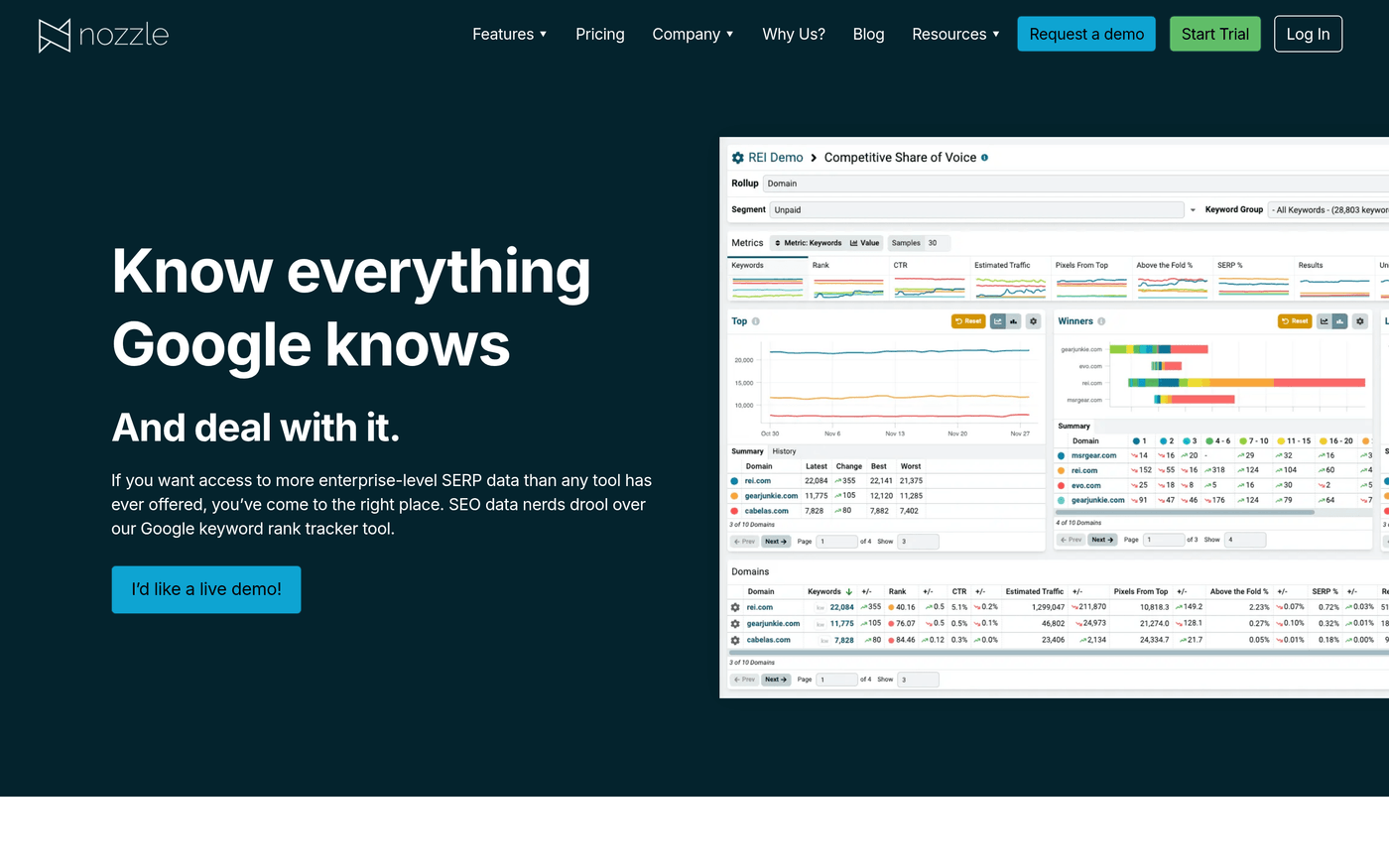
Best for: Data-led SEO teams and agencies with analysts who regularly investigate SERP features and large keyword sets.
Nozzle makes more sense when a team cares about the anatomy of a results page as much as the headline rank. Enterprise analysts may want to distinguish an ordinary organic result from a shopping module, local pack, featured snippet, or another result type. That level of detail is valuable when a keyword appears to improve in position but attracts fewer clicks because the page layout changed.
A typical enterprise implementation would divide keywords by brand, country, device, and business unit before looking at visibility trends. With Nozzle, the analytical opportunity is extensive, but the cost of that flexibility is a steeper operational setup. Teams should decide in advance who will maintain tags, scheduled exports, and interpretation standards.
What to look for
- Practical strength: Detailed SERP intelligence and custom segmentation.
- Before purchasing: Clarify whether usage is billed per SERP collected, per keyword, or per location-device combination; a small tracking experiment may significantly understate the scale of a national rollout.
Velautec perspective: Request an export sample and verify that every SERP element can be traced back to an individual keyword.
3. STAT Search Analytics — Best for high-volume keyword tracking across markets
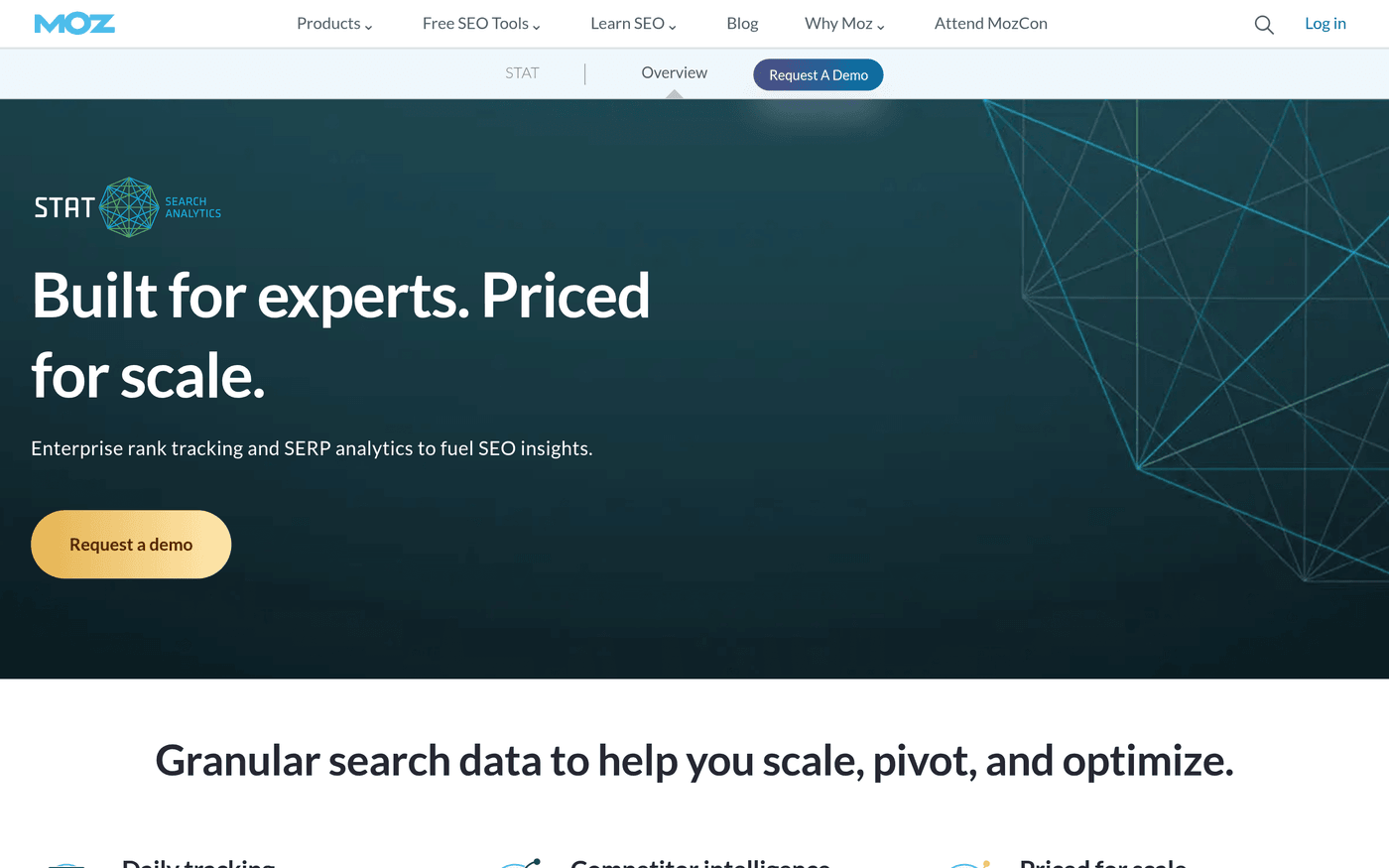
Best for: Retail, marketplaces, publishers, and large agencies with substantial keyword portfolios and regular market-level reporting.
STAT is built around the challenge of taking a very large collection of search terms and making it useful at category and market level. Rather than celebrate isolated keyword movements, an enterprise can measure whether an entire product line is gaining visibility against a defined set of competitors. This makes STAT attractive when SEO leaders manage large catalogues, multiple countries, and hundreds of commercial topic clusters.
It works especially well as a specialist component of a wider measurement stack. A business may use STAT for consistent SERP tracking, another platform for technical audits, and its own BI environment for revenue analysis. The critical implementation choice is taxonomy: product groups, regions, customer intent, and ownership need consistent labels to make the data actionable.
What to look for
- Practical strength: High-volume keyword tracking across markets.
- Before purchasing: Budget for keyword quantity, regional coverage, refresh frequency, and any BI or API requirements. A dedicated tracking platform does not eliminate the need for content and technical SEO operations.
Velautec perspective: Validate market-level share of voice against the segments your sales team uses.
4. Semrush — Best for competitive research combined with rank tracking
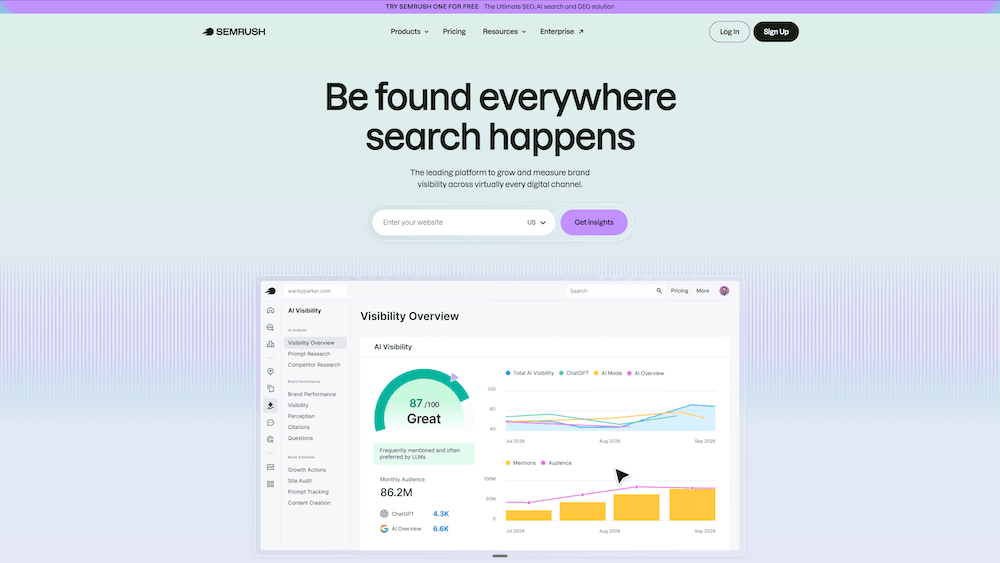
Best for: Agencies wanting keyword discovery, competitor research, and scheduled rank reporting in one main interface.
Semrush offers an efficient path for teams that want to move from a ranking report into competitive research without changing tools. A loss in visibility can lead directly to checking competing domains, researching new keywords, or reviewing how organic features are changing. That connected workflow is particularly useful to agencies handling many small-to-mid enterprise accounts.
The trade-off is specialization. An all-in-one platform can be excellent for planning and executive reporting while still offering less granular SERP history than a dedicated rank-data product. Large buyers should review how many projects, tracked terms, locations, users, and daily refreshes are available at their intended subscription tier.
What to look for
- Practical strength: Competitive research combined with rank tracking.
- Before purchasing: Validate the exact plan limits and any charges for additional users, projects, AI visibility, or data access. Enterprise procurement should compare total ownership cost, not only the introductory subscription.
Velautec perspective: Test position alerts against actual SERPs in three priority locations.
5. Ahrefs — Best for connecting ranking changes to backlinks and content opportunities
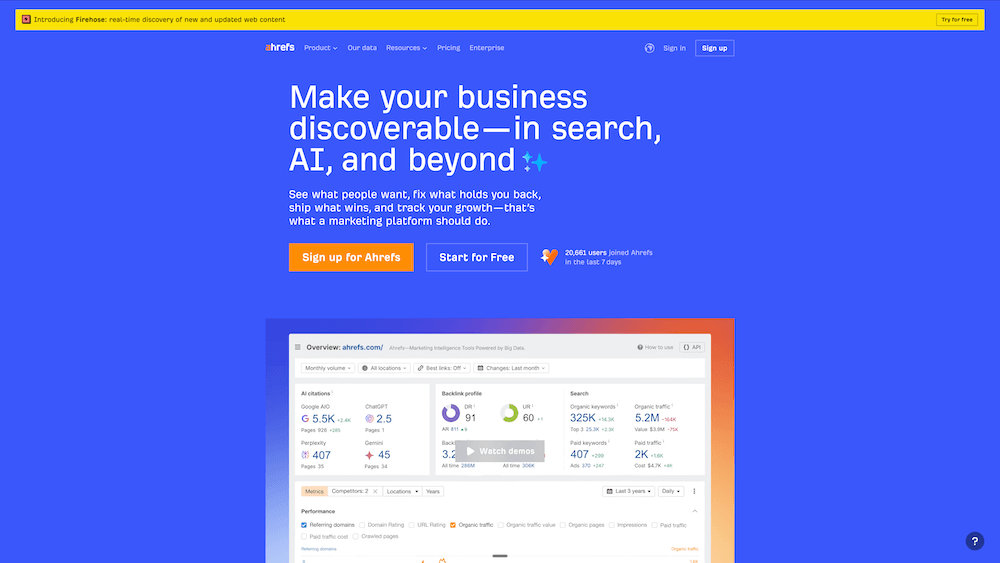
Best for: In-house SEO teams and agencies that already depend on backlink intelligence and content-gap analysis.
Ahrefs is useful when a team approaches search visibility as a combination of rankings, links, topical coverage, and competitor activity. When a priority page slips, an analyst can examine whether competitors gained relevant referring domains, published stronger resources, or started covering adjacent queries. That breadth can make Ahrefs a strong investigative workspace.
An enterprise rank-tracking purchase still deserves careful scrutiny. Tracking frequency, geographic precision, device splits, keyword quotas, and historical exports should match the organization’s reporting requirements. A familiar research platform is not automatically the best primary source for every complex enterprise dashboard.
What to look for
- Practical strength: Connecting ranking changes to backlinks and content opportunities.
- Before purchasing: Check refresh and geographic coverage for the exact markets you report on; where the contract requires daily city-level figures, test them before using them in client-facing service agreements.
Velautec perspective: Review keyword history alongside referring-domain trends and content updates.
6. seoClarity — Best for governed enterprise seo reporting and workflows
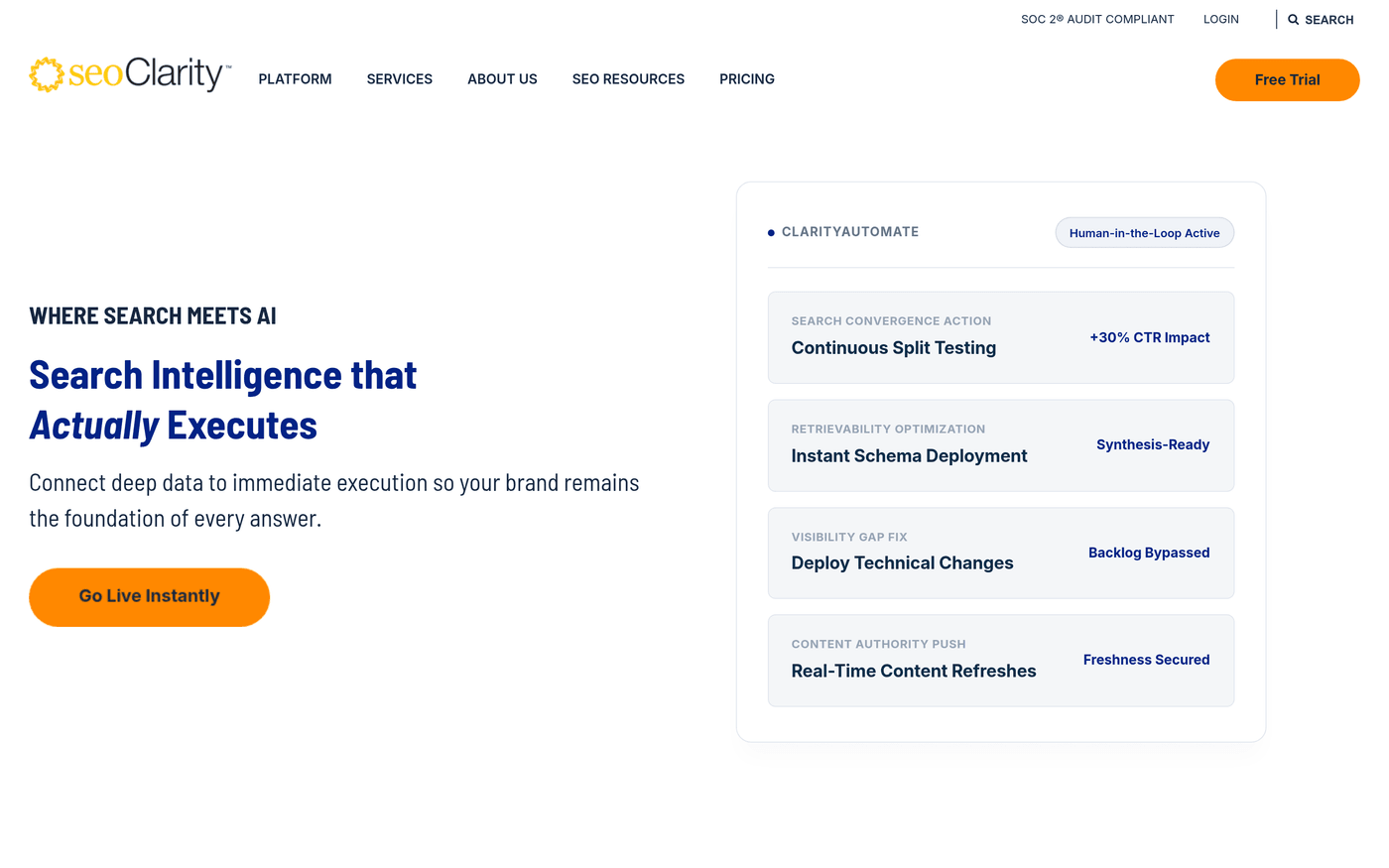
Best for: Global marketing departments that need shared reporting standards, role management, and connected SEO execution.
seoClarity is oriented toward organizations where collecting rank data is just one part of a larger operating system. Large SEO programs have to move from findings to prioritization, implementation, review, and executive reporting while keeping different teams aligned. Integrated analytics and workflow capabilities can help reduce the amount of information that gets lost during those handoffs.
This is a platform to evaluate with real stakeholders in the room. Invite a technical SEO lead, a regional marketing manager, a content owner, and the person responsible for BI. Have each complete a short task during a proof of concept. The value of an enterprise suite depends as much on adoption and governance as on the range of charts it can display.
What to look for
- Practical strength: Governed enterprise SEO reporting and workflows.
- Before purchasing: Get a written scope for data history, onboarding, integrations, support, and implementation. A feature-rich solution can become an expensive dashboard if teams never adopt its workflows.
Velautec perspective: Make workflow adoption part of the proof of concept, not an afterthought.
7. BrightEdge — Best for executive reporting and standardized seo programs
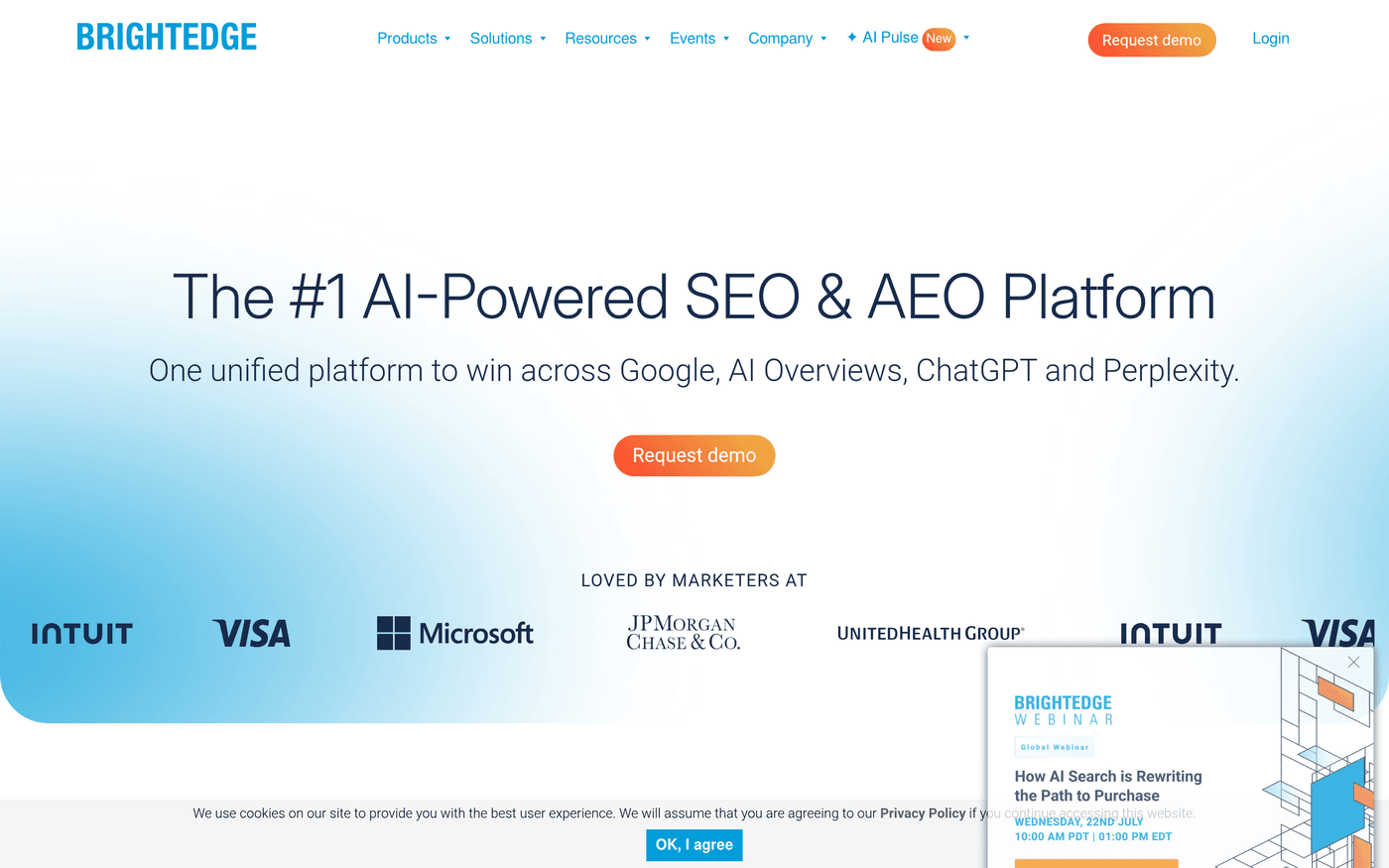
Best for: Large enterprises that prioritize common reporting definitions and stakeholder accountability over lightweight tool administration.
BrightEdge serves organizations that need consistent search intelligence across large teams. At that scale, the problem often shifts from obtaining rankings to agreeing on what should be measured, how to present progress, and who can act on the information. Centralized reporting can be especially useful for leadership reviews where dozens of sites or markets are represented.
The procurement discussion should focus on governance and outcomes. Ask what the system can show for a multi-brand scorecard, how visibility is segmented by market, and how content recommendations are assigned. Compare the implementation effort with the number of teams that will genuinely use the platform each month.
What to look for
- Practical strength: Executive reporting and standardized SEO programs.
- Before purchasing: This is typically a custom commercial discussion. Request a detailed demonstration and quote rather than treating estimated third-party price ranges as official pricing.
Velautec perspective: Require a reporting prototype for one executive and one hands-on analyst.
8. Conductor — Best for collaboration across content, seo, and web teams
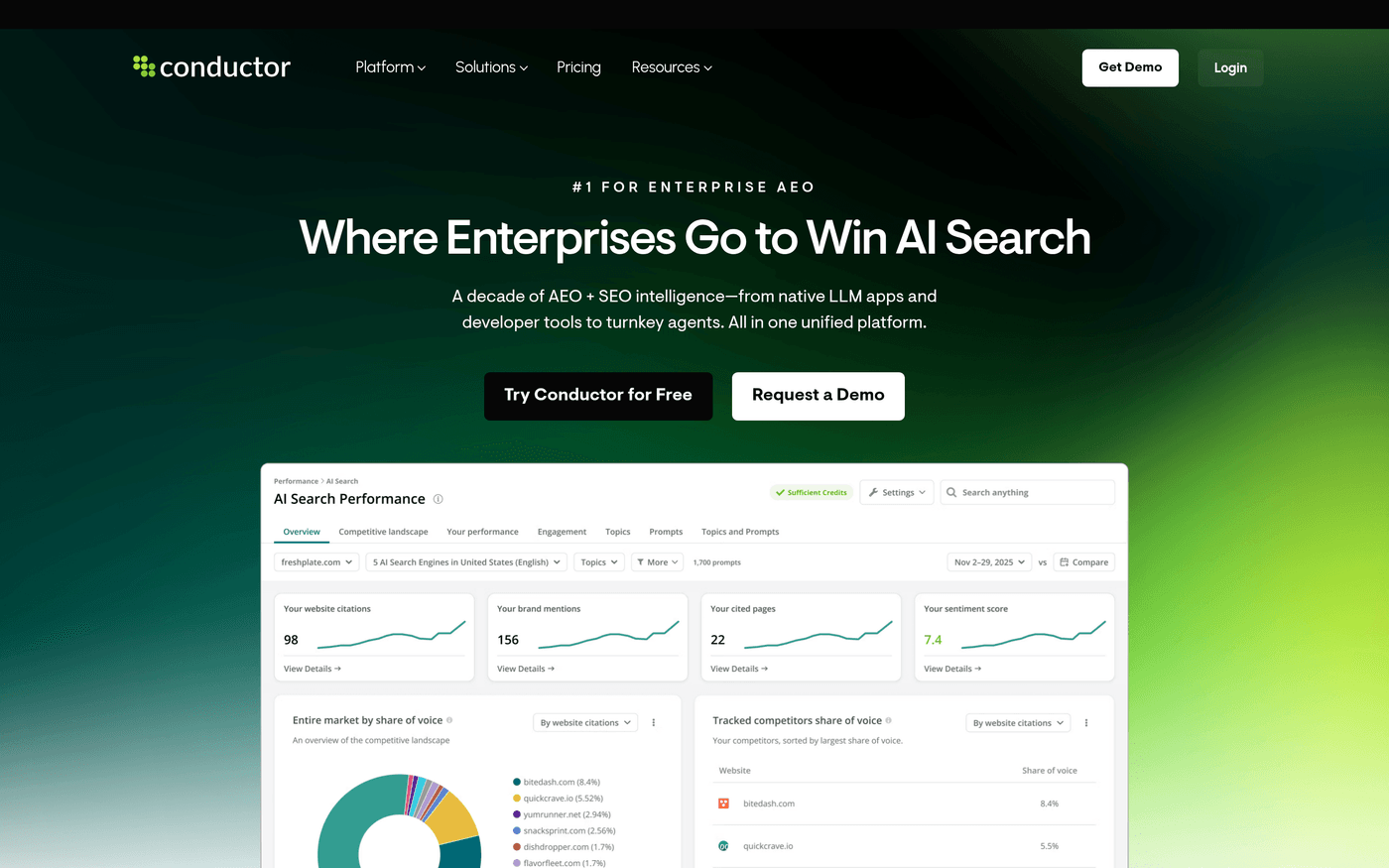
Best for: Organizations investing in shared SEO processes across multiple departments, websites, and business lines.
Conductor is appealing when SEO research has to become coordinated action across content teams, web development, and business stakeholders. Tracking rankings is useful, but the larger benefit comes from identifying an opportunity and making its next step clear to the people who can implement it. Its wider search and AI positioning reflects the increasing overlap between traditional SEO and answer-engine visibility.
For an enterprise rollout, test whether dashboards can be translated into repeatable editorial decisions. Ask one team to diagnose a topic cluster, another to propose page updates, and a manager to report on implementation. If the handoff is difficult, additional dashboard features will not solve that bottleneck.
What to look for
- Practical strength: Collaboration across content, SEO, and web teams.
- Before purchasing: Confirm the specific data sources, platform coverage, reporting permissions, and integrations included in the proposed package; offerings can vary by contract.
Velautec perspective: Evaluate whether content and technical teams can act on the exported insights.
9. SEOmonitor — Best for seo forecasting and business-oriented reporting
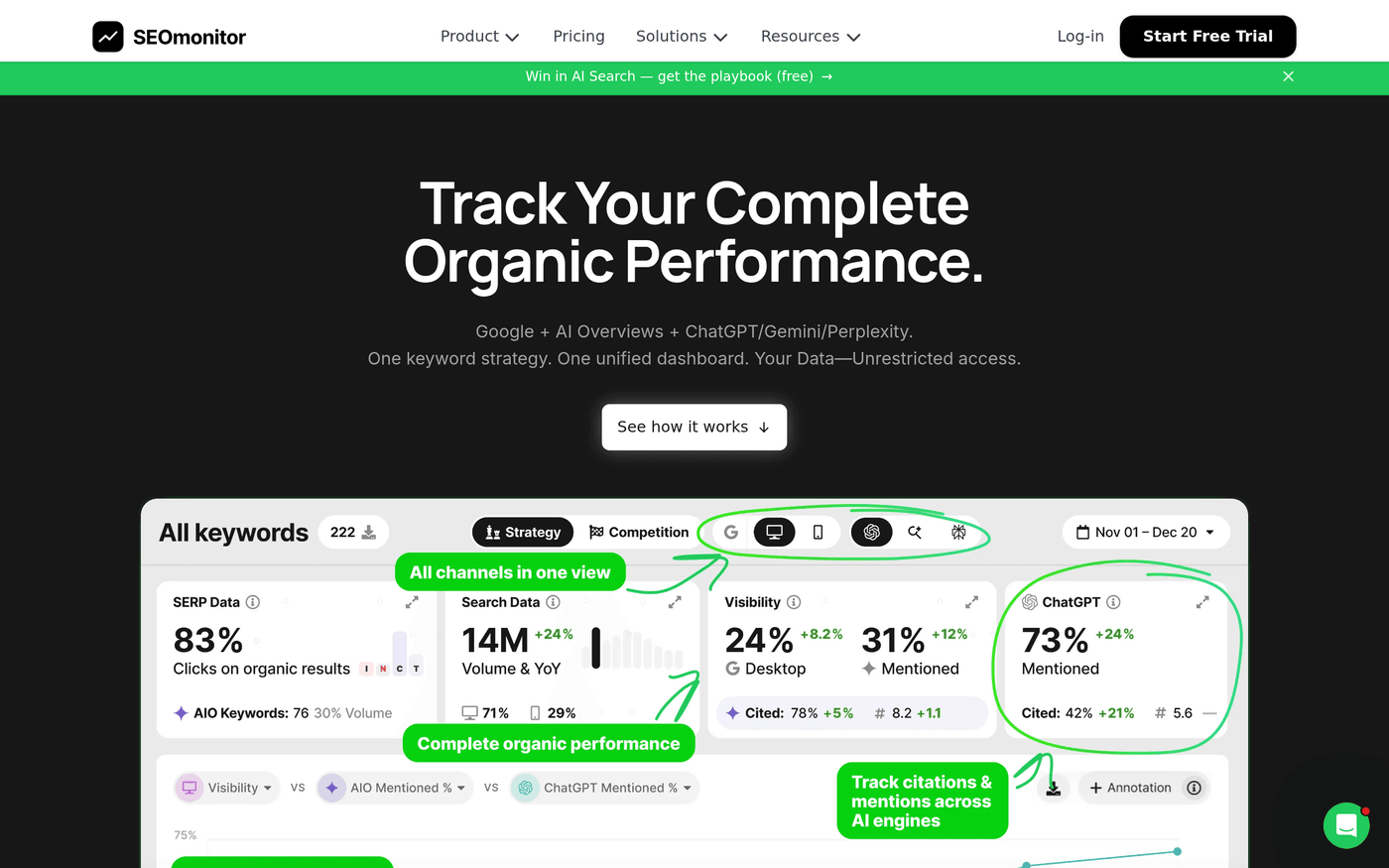
Best for: Agencies defending SEO investment, creating proposals, and providing recurring performance updates to commercial leaders.
SEOmonitor is particularly relevant when ranking movement must support budget and forecasting conversations. An agency pitching a large engagement needs more than a list of target keywords: it must explain assumptions, estimated opportunity, and how the proposed work might affect visibility. Forecast-led reporting is a natural fit for those requirements.
Forecasts become more credible when the underlying assumptions are explicit. Keyword demand, target position, expected click-through rate, seasonality, and the time needed to implement recommendations all affect the outcome. Use the platform to facilitate a commercial discussion, not to promise a fixed traffic or revenue result.
What to look for
- Practical strength: SEO forecasting and business-oriented reporting.
- Before purchasing: Ask about usage-based tracking costs and whether multi-location keywords count separately. Maintain a distinction between modeled opportunity and measured revenue.
Velautec perspective: Compare forecast assumptions with Search Console reality before presenting ROI.
10. Similarweb — Best for market context and competitive traffic intelligence
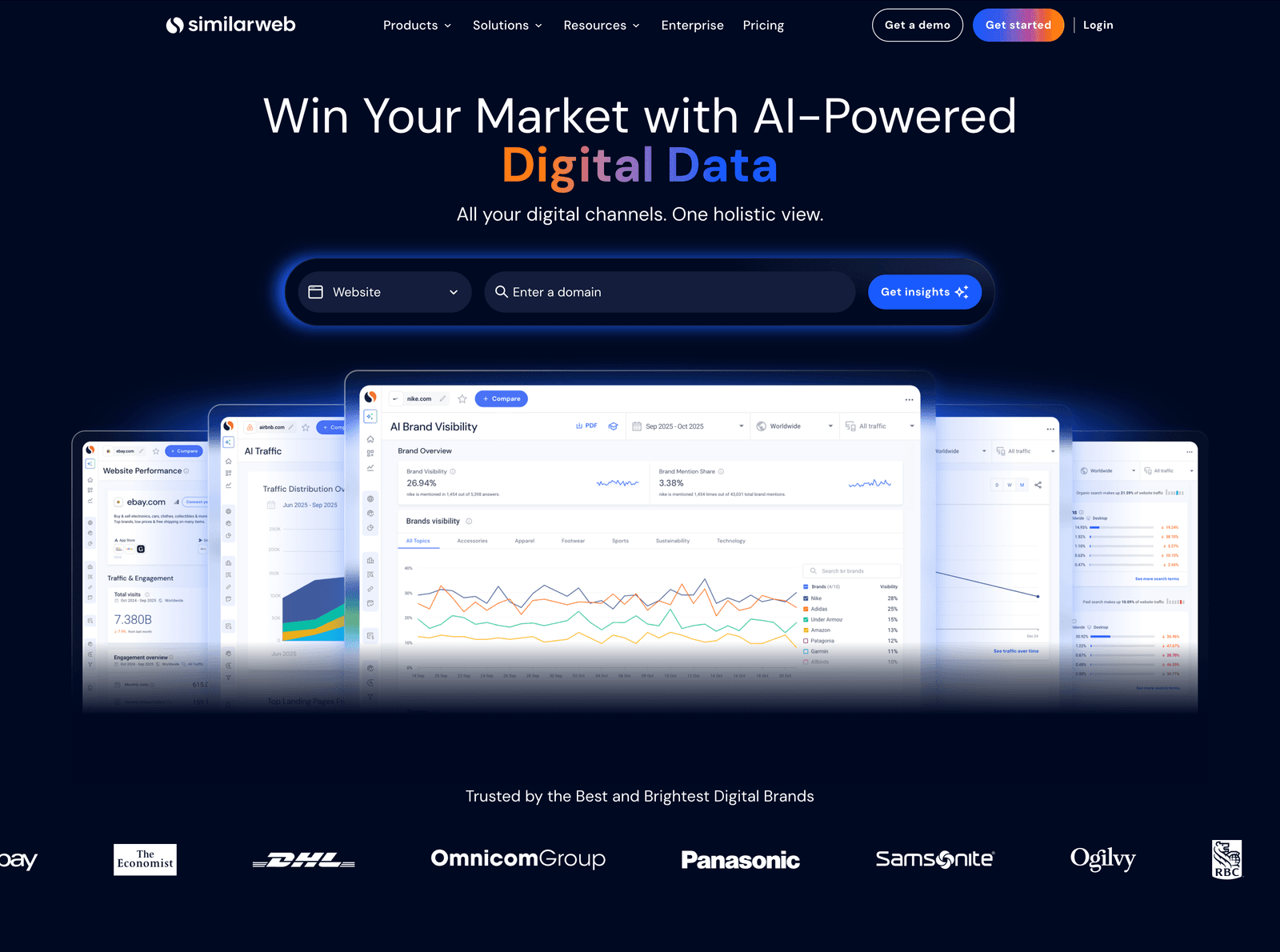
Best for: Corporate marketing teams and consultancies responsible for competitive market share, category benchmarking, and strategic planning.
Similarweb is the most useful addition when the executive question is broader than “Where do we rank?” A brand may improve positions for its tracked terms but still lose market share because the category is shifting, new competitors emerge, or other channels gain importance. Broader digital market intelligence helps put those ranking wins and losses into perspective.
Similarweb should often be treated as a complementary lens rather than a substitute for dedicated daily rank monitoring. It can help identify competitors, market trends, and category-level traffic signals, while another tracker handles the precise keyword-location history required by SEO operations.
What to look for
- Practical strength: Market context and competitive traffic intelligence.
- Before purchasing: Check which countries, traffic segments, exports, and data histories are included. Modeled market intelligence and observed keyword ranks answer different questions.
Velautec perspective: Use market estimates as directional context rather than precise rank observations.
Enterprise rank tracking vs. AI visibility monitoring
Traditional rank tracking answers a precise question: where did a URL appear for a query, device, location, and date? AI visibility monitoring asks a different set of questions: was the brand mentioned, was the site cited, how was it described, and which competitor was recommended? These are complementary data sets rather than interchangeable scores.
For leadership reporting, show them separately before rolling them into a combined score. A stable Google rank does not guarantee a brand will be mentioned in an AI-generated answer, and a citation does not necessarily generate a visit. A credible enterprise dashboard distinguishes observed positions, estimated reach, AI mention frequency, source citations, and business outcomes.
What enterprise rank tracking really costs
A low monthly starting price rarely reflects a full enterprise deployment. Compute total cost using keywords, locations, devices, update cadence, reporting seats, historical retention, and data exports. For example, tracking 5,000 keywords in 20 cities on two devices represents up to 200,000 keyword-location-device combinations per collection cycle. Billing models vary, so a product with a lower entry price can become more expensive when local market coverage expands.
Several enterprise platforms use custom contracts rather than universally published pricing. Compare vendors using the same written scope, and separate one-time onboarding or implementation fees from recurring subscriptions. Ask for predictable overage terms and a clear exit process for your data.
A practical 30-day enterprise evaluation checklist
- Week 1 — Setup: Load one brand, two locations, desktop and mobile data, and 100 high-value commercial keywords.
- Week 2 — Validation: Spot-check ranking reports against the same location and device settings, and review unexpected movements.
- Week 3 — Reporting: Build an analyst report and a one-page executive summary; test exports and permissions.
- Week 4 — Decision: Compare support quality, total cost at scale, workflow adoption, and whether the findings led to useful SEO changes.
Frequently asked questions
What is the best enterprise rank tracking software?
There is no single winner for every enterprise. Nozzle and STAT focus on SERP depth and keyword scale, Semrush and Ahrefs help with wider SEO research, seoClarity and Conductor can support coordinated programs, while Similarweb adds market context. Choose based on your reporting and implementation requirements.
How is enterprise rank tracking different from a standard SEO rank checker?
Enterprise software usually adds multi-market scale, flexible segmentation, long-term data history, automated reporting, governance and integration options. A standard checker may be sufficient for a handful of keywords and one website, but is less suitable for complex organizations.
Should rank tracking update daily?
Daily updates are valuable for competitive or fast-moving categories, but the right frequency depends on business needs and pricing. A monthly executive review may not require every keyword to be collected hourly. Define high-priority and long-tail keyword tiers.
Can these platforms track Google AI Overviews and ChatGPT?
Some vendors offer AI-related visibility modules, but support and definitions vary. Check whether the product measures classic SERP features, AI-generated citations, chatbot mentions, or all three. Do not assume they are identical.
Can we combine Google Search Console with a rank tracker?
Yes. Search Console provides observed search impressions, clicks and query performance, while tracking software provides a consistent list of chosen terms and locations. Combining them helps explain changes without assuming that rank directly equals traffic.
What should a global organization ask before signing?
Request the exact scope for countries, languages, locations, devices, keyword count, historical data, users, API availability, data processing, support commitments, renewal terms, and cancellation or export provisions.
Final recommendation: buy a reporting system, not just a rank chart
The most suitable enterprise rank tracker is the one that makes important commercial decisions easier. Begin with the questions your team needs answered, run a realistic multi-location pilot, and check whether the data can flow into the reports your business actually uses. A specialist tracker may be the right source of truth for rankings; an enterprise SEO suite may be better for coordinating the work that follows.
Need help translating rankings into qualified leads? Velautec helps growth teams and agencies connect technical SEO, content, local search visibility, and measurement to commercial opportunities. Learn more about our approach at Velautec Media.
Editorial methodology: We reviewed publicly described capabilities and use cases for the ten platforms, then organized the comparison around enterprise decision criteria. This is an independent editorial buying guide, not a claim that each platform underwent a controlled benchmark. Screenshots come from externally hosted source imagery; image rights and availability should be checked before publication.


