There’s an important misunderstanding happening right now in SEO and AI-generated content.
Many people believe that if content is written with AI, optimized correctly, and formatted nicely, it should rank well in Google. But after running multiple real-world SEO tests, I’ve learned that what actually matters is not whether AI helped create the content — it’s whether the content offers something singular, coherent, and deeply connected to the website’s reputation and audience.
AI can improve grammar.
AI can improve clarity.
AI can organize ideas.
But AI alone cannot replicate real-world testing, niche obsession, industry experience, or a creator’s authentic perspective.
That is where the difference begins.
The Problem With Generic AI Content
Most AI systems work by prediction.
They analyze patterns and calculate what word is most likely to come next based on existing information already available online. In other words, they reproduce patterns that already exist.
This creates a major issue:
If your content does not contain something unique, experiential, or deeply aligned with your niche, it becomes interchangeable with thousands of other pages on the internet.
Google is getting much better at detecting this.
In my own workflow, I use AI primarily to improve grammar, structure, tone, and readability around ideas or experiments I personally bring to the table. The outline, positioning, examples, and perspective come from real SEO testing and experience.
That distinction matters more than ever.
My Real SEO Experiment That Failed
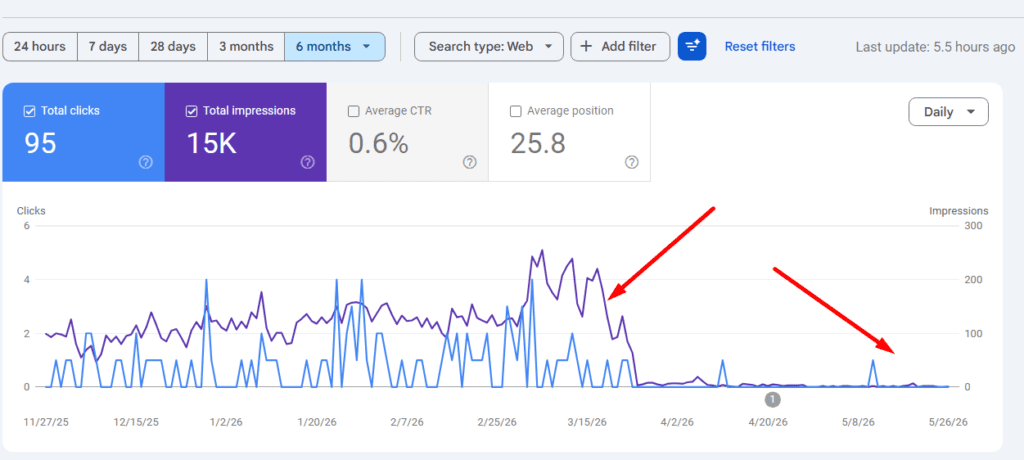
Recently, I tested something on one of my websites.
The domain originally focused on party supplies and event-related content. Over time, I experimented with changing the site into an online calculator hub. Surprisingly, the calculators gained traction for a few months. The site started receiving impressions and traffic.
But eventually, Google removed almost all visibility from the website.
Why?
Because Google understood there was a mismatch between the domain’s established reputation and the new content direction.
The topical authority broke.
The website had spent years building signals around one industry, one audience, one identity. Suddenly, the content shifted into something unrelated.
Even though some pages initially performed well, Google eventually decided the overall experience was inconsistent and stopped surfacing the site in search results.
Honestly, I suspected this would happen.
Google has become significantly smarter than it was years ago.
Google Is Measuring Reputation Coherence
One of the biggest lessons from this experiment is that Google seems to care deeply about coherence.
Not just content quality.
Not just backlinks.
Not just keywords.
But coherence.
It’s almost like Google develops an “idea” of what your website represents on the internet — your tone, your expertise, your niche, your audience, your authority, and the type of problems you solve.
And once that identity is established, changing it abruptly creates friction.
It’s similar to reputation in the real world.
If people know you as a construction marketing agency, but tomorrow you suddenly become a cryptocurrency blog, the transition feels unnatural. Google appears to evaluate websites the same way.
Everything needs to feel connected:
- The niche
- The backlinks
- The mentions
- The language
- The audience
- The business signals
- The geographic relevance
- The expertise
- The structure of the content
If these signals stop aligning, Google may classify the site as inconsistent or less trustworthy.
Why Topical Authority Matters More Than Ever
Right now, I’m running another test.
I removed unrelated content from the domain and refocused the site entirely around its original niche and reputation. The goal is to rebuild topical consistency and reinforce the authority the domain had already earned over time.
So far, the signals strongly suggest that Google rewards this type of alignment.

And this makes sense considering where search is heading.
Google is increasingly integrating Gemini and AI-driven systems into search experiences. Search results are becoming less static and more dynamic, relying heavily on entity understanding, brand reputation, and contextual trust.
This means Google isn’t only evaluating pages anymore.
It’s evaluating identity.
What I Saw With My Marketing Agency Website
I noticed this directly with my own agency website.
When searching for terms like “Digital Marketing Agency for Contractors in Lima,” AI-driven search experiences and Google itself started associating my brand strongly with that niche.

Why?
Because the signals are aligned:
- The website talks consistently about construction marketing
- The content focuses on delivering results for that industry
- The structure reinforces the niche
- The authority signals support the positioning
- The messaging is coherent
- The expertise is specific
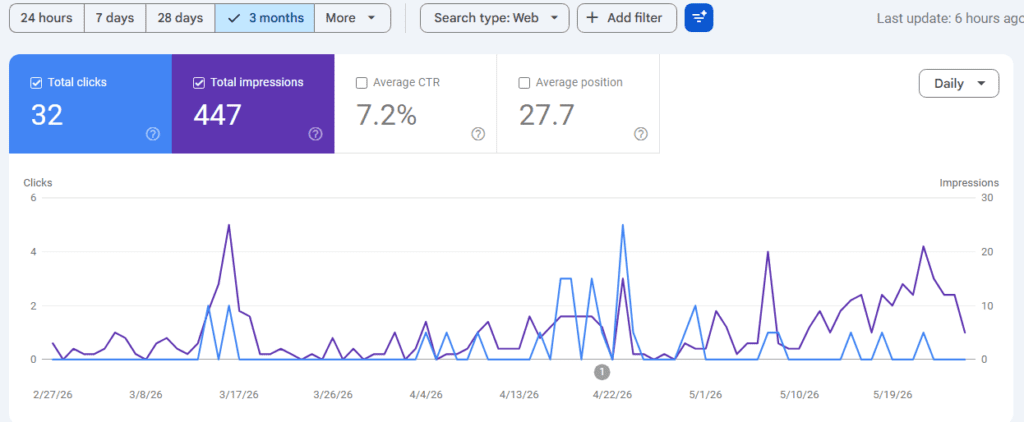
As a result, Google Search Console rewards the site with stronger impressions, healthier indexing, and better rankings. The website becomes easier for search engines to understand. And understanding leads to trust. In the B2B industry you need quality traffic, here bellow even if the number shows 32 clicks, one conversion or lead generated can pau off the whole year of marketing efforts with great ROI, same principle applies for our clients which are companies in the mining industry, Construction, Remodeling, etc.
Freshness Still Matters
Even if your site has strong topical authority, freshness still matters.
If Google must evaluate your website against an older competitor, the businesses that continue publishing updated, relevant, niche-focused content often gain an advantage over time.
The key is not appearing quickly.
The key is appearing with content that is:
- Relevant
- Updated
- Consistent
- Useful
- Niche-aligned
- Experience-driven
That’s what builds sustainable rankings today.
The Future of SEO Is Reputation
SEO is no longer just about keywords.
It’s about reputation.
It’s about consistency.
It’s about topical authority.
It’s about how the internet perceives your business as a whole.
Everything contributes:
- Links
- Mentions
- Business profiles
- Reviews
- Geography
- Industry relevance
- Content structure
- Expertise
- User engagement
- Freshness signals
All of these elements help AI crawlers and search engines better understand who you are and whether your content deserves visibility.
The websites that will win in the future are not the ones publishing the most AI content.
They are the ones creating the clearest, most coherent identity online.
If you need help building that authority and aligning your SEO strategy with how modern search engines actually work, we’d be happy to help.

SEO Specialist & Founder of Velautec | Local SEO & Lead Generation for Service Businesses
I help law firms, contractors, and service-based businesses dominate local search results and turn Google visibility into consistent leads.
Over the past 6+ years, I’ve led SEO strategies across international teams, focusing on high-impact improvements in rankings, traffic, and conversions. My work combines technical SEO, Google Business Profile optimization, and conversion-driven content to create systems that generate real business growth.
As the founder of Velautec, I work with businesses in the U.S. and Latin America to improve their online presence, increase inbound leads, and build long-term authority in their markets.