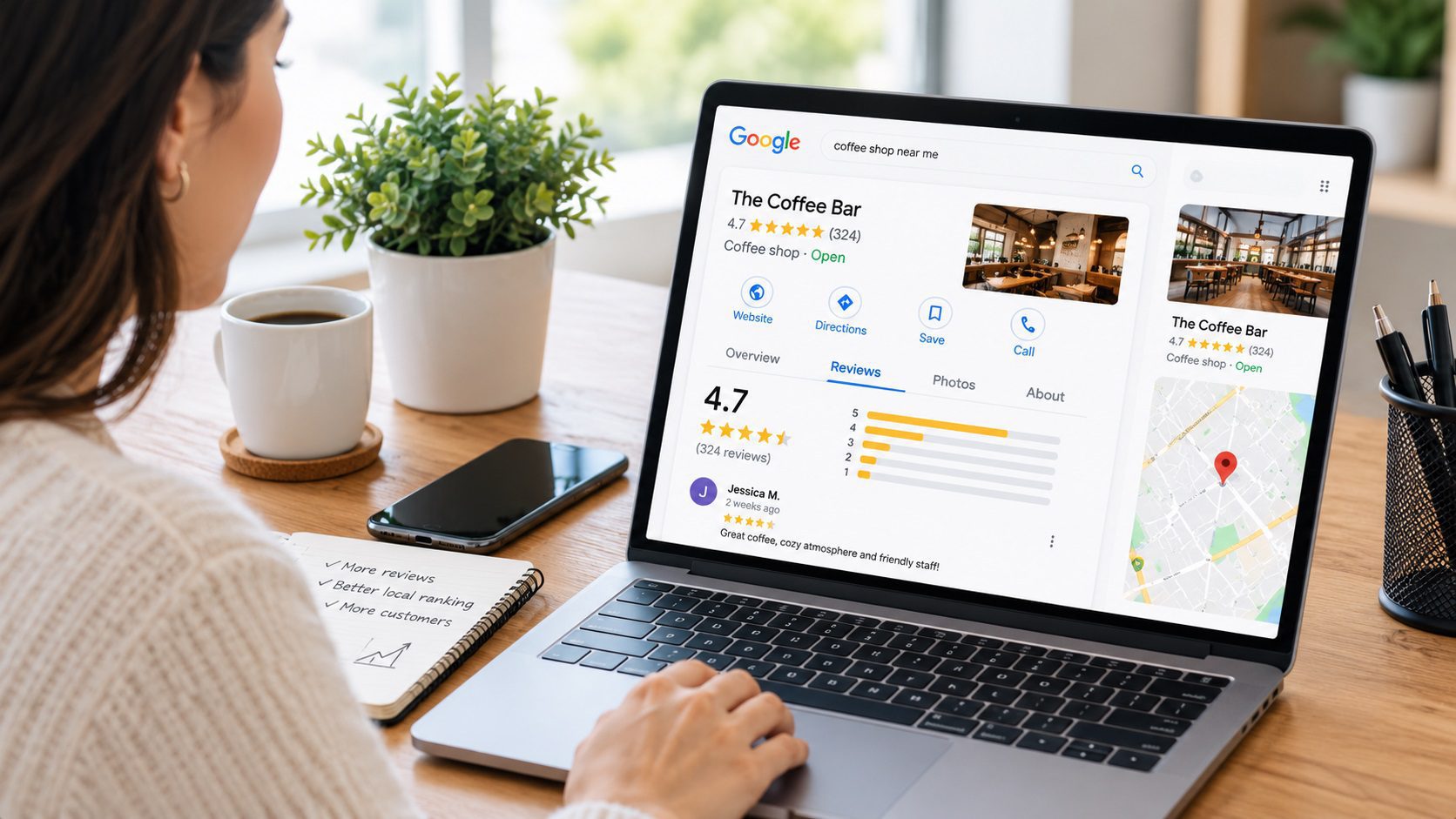
A contractor can be five minutes from a customer, have great reviews, and still disappear below competitors in Google Maps.
That is the frustrating part of local search: proximity helps, but it is not the only thing Google evaluates.
Google says local rankings are mainly based on relevance, distance, and prominence. That means a business needs more than a pin on the map. Its Google Business Profile, website, reviews, links, categories, services, and location signals all need to help Google understand what the business does, where it operates, and why it may be a strong match for the search.
This guide explains how Google Maps SEO works and what local businesses can actually improve.
What Is Google Maps SEO?
Google Maps SEO is the process of improving a business’s visibility in local results on Google Maps and Google Search.
The goal is usually to appear more often for searches such as:
- roofer near me
- HVAC contractor near me
- plumber in Tampa
- commercial roofing company
- best remodeling contractor nearby
According to Google’s official local ranking guidance, the three main factors are relevance, distance, and prominence.
That gives us a much better strategy than simply asking, “How do I get more reviews?”
1. Make Google Understand Exactly What You Do
Imagine two roofing companies.
The first has a Business Profile categorized broadly, a homepage that says “quality exterior solutions,” and no dedicated roof-repair page.
The second clearly identifies itself as a roofing contractor, lists relevant services, and has individual pages for roof repair, replacement, storm damage, and commercial roofing.
Even if both businesses are nearby, the second gives Google far more context.
Google defines relevance as how well a Business Profile matches what someone is searching for. Google recommends providing complete and detailed business information to improve that match.
Start by reviewing:
- Primary category
- Additional categories
- Services
- Business description
- Hours
- Website URL
- Phone number
- Service areas
For contractors, this should connect directly with the website. A good local SEO strategy for contractors makes the Business Profile and website reinforce the same services and markets.
2. Do Not Treat Distance Like Something You Can “Hack”
This is where many local SEO promises become unrealistic.
Google says distance is a core local ranking factor. If a user does not specify a location, Google estimates where the person is and considers how far businesses are from that searcher.
That means rankings can change across the same city.
A contractor may appear near the top of Maps close to its office but drop several positions fifteen miles away.
No legitimate optimization can completely remove geography from local search.
Instead, focus on the areas you genuinely serve and make those markets clear across your website and Google Business Profile.
3. Build Real Prominence, Not Just More Listings
Prominence is Google’s way of considering how well-known a business is.
Google says this can include information such as links to the business and review signals. More reviews and positive ratings can help local ranking, but reviews are not the entire system.
A local contractor might build prominence through:
- Real customer reviews
- Links from relevant websites
- Local news coverage
- Industry organizations
- Supplier or manufacturer directories
- Local sponsorships
- Useful content that earns references
This is why buying hundreds of random directory listings is not the same as building local authority.
Your broader SEO for contractors strategy should support the Maps profile rather than treating local SEO as an isolated tactic.
4. Reviews Help, but Review Count Alone Does Not Win
A contractor with 150 reviews can still rank below one with 60.
Why?
Because relevance, distance, website authority, categories, links, and other local signals still matter.
Reviews should be part of a consistent customer process, not a one-time campaign.
If you want customers to leave feedback, make the process simple. We created a separate guide on how to leave a Google review that can also be shared with customers who are unsure how the process works.
Businesses should request genuine feedback rather than attempting to manipulate ratings.
5. Your Website Still Matters for Google Maps
One of the biggest local SEO mistakes is optimizing the Google Business Profile while ignoring the website linked from it.
Google says information used in Business Profiles can come from publicly available web content, including a business’s official website. You can read more about this in Google’s explanation of how it sources business information.
Your website should clearly answer:
- What does the company do?
- Where does it operate?
- What services have their own search demand?
- How can someone contact the business?
- Why should a customer trust it?
For example, a roofing company should not rely on one generic Services page if customers search separately for roof repair, replacement, commercial roofing, and storm damage.
The website and Google Business Profile should tell the same story.
6. Make Important Local Pages Easy to Find
A strong service page does little if it is buried six clicks deep.
Important pages should be supported by internal links from relevant areas of the site, such as:
- Homepage
- Main navigation
- Service hubs
- Related services
- Relevant blog posts
- Useful location pages
Do not create dozens of near-identical city pages just to insert location names.
A location page should genuinely help a customer understand whether the company serves that market and what services are available there.
7. Add LocalBusiness Structured Data Where It Makes Sense
Structured data will not magically move a business into the top three Maps results, but it can help Google understand information about a local business.
Google’s LocalBusiness structured data documentation explains how websites can provide information such as business details and hours in a standardized format.
Use the most specific valid business type available and make sure the structured data matches the information users can actually see on the site.
What Should You Fix First?
If your business is not ranking well on Google Maps, use this order:
- Verify the Business Profile.
- Check the primary category and services.
- Make sure the business information is accurate.
- Review the pages linked from the profile.
- Improve service and location relevance.
- Build a consistent review process.
- Earn legitimate local and industry authority.
- Measure rankings from multiple areas, not one device.
The biggest mistake is trying to fix every Maps problem by getting more reviews or buying more backlinks.
First identify which of Google’s three core factors is weakest: relevance, distance, or prominence.
The Business Closest to the Customer Does Not Always Win
That is the twist.
A nearby competitor can lose to a business slightly farther away if Google believes the other result is a stronger match.
Google itself explains that its algorithms can decide a farther business is more relevant to a search and rank it higher.
That means Google Maps SEO is not about finding one secret trick.
It is about making your business easier for both Google and customers to understand and trust.
Want Google Maps Visibility to Turn Into Actual Leads?
Here is the cherry on top: ranking in Maps only matters if the person who finds you eventually calls, requests a quote, or becomes a customer.
Velautec helps contractors and service businesses connect local SEO, SEO strategy, and conversion-focused websites so visibility supports real lead generation.
If you run a marketing agency, Velautec can also work behind the scenes as an SEO execution partner for your local-business clients.
Sources
- Google Business Profile Help: Tips to improve your local ranking on Google
- Google Business Profile Help: How Google sources and uses business information
- Google Search Central: LocalBusiness structured data
- Unsplash: Local SEO / Google Maps photo by Henry Perks
- Unsplash: Smartphone map photo by Perry Merrity II
The Velautec SEO Team specializes in Local SEO, lead generation, and organic growth strategies for service-based businesses.
With more than 6 years of experience working across international markets, the team develops SEO strategies for law firms, contractors, and service companies in the U.S. and Latin America.
Our approach combines technical SEO, Google Business Profile optimization, local search strategy, and conversion-focused content to improve rankings, attract qualified traffic, and generate consistent inbound leads.
At Velautec, we focus on building sustainable search visibility, stronger online authority, and measurable business growth.
For businesses and marketing teams
If you are evaluating improvements for your business, explore the service scope related to this guide.